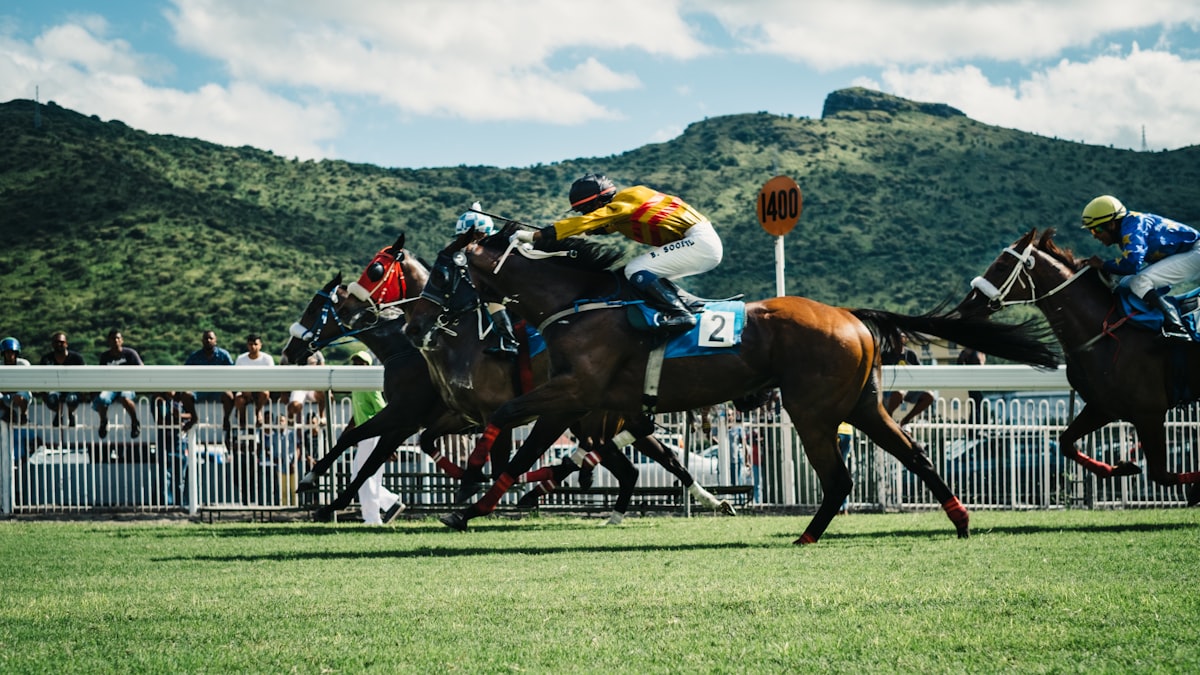
The going is the official description of how soft or firm the ground is. It sounds simple enough, but going is one of the most underrated factors in horse racing. We’ve seen plenty of punters spend an hour studying form and forget to check whether their fancy actually handles the ground. That’s a costly oversight.
The going scale
On turf in the UK, the going descriptions run from driest to wettest:
- Hard – very rarely used, generally considered dangerous
- Firm – fast, dry ground
- Good to Firm – slightly quicker than average
- Good – standard conditions, what most form is run on
- Good to Soft – starting to get some give
- Soft – significant give in the ground, demanding
- Heavy – waterlogged, extremely testing
You’ll also see combinations like “Good to Firm in places” or “Good, Good to Soft in places” which mean conditions vary across different parts of the course.
All-weather surfaces (Polytrack, Fibresand, Tapeta) have their own scale: Fast, Standard to Fast, Standard, Standard to Slow, Slow. These surfaces are more consistent than turf but they do vary, and the different surface types (Lingfield’s Polytrack versus Southwell’s Fibresand, for example) ride quite differently from each other.
Why it matters so much
Different horses have different physical attributes, and those attributes suit different ground conditions. A big, rangy horse with a long stride often struggles to get purchase on soft ground – their feet sink in and they can’t generate the same power. A lighter, nimbler horse might skip over the top of soft ground but struggle on firm, where the jarring impact of each stride takes a toll.
This isn’t just received wisdom. It’s real and measurable. We ran the numbers across our database and the impact is stark in some cases.
What the data says
We looked at horses that had run at least 5 times on Good or faster ground and at least 5 times on Soft or Heavy, to get a fair comparison for each individual horse. That gave us a sample of just over 14,000 horses across flat and jump racing combined.
Of those:
- 38% showed a clear preference for quicker ground (their win rate was at least 50% higher on Good+ than on Soft/Heavy)
- 29% showed a clear preference for softer ground
- 33% showed no strong preference either way
That last group is important. A third of horses genuinely don’t seem to mind, which means going preference isn’t universal. But for the other two-thirds, running on the wrong ground significantly hurts their chance.
Flat racing
On the flat, the going effect is most pronounced in sprint races. Over 5 and 6 furlongs, speed is everything, and soft ground slows horses down unevenly. Quick-ground specialists lose more ground (literally) than they do over longer trips where stamina becomes a bigger factor.
We pulled the figures for sprint handicaps on turf (5f-6f, Class 2-6) across the last five seasons:
| Going | Favourites winning | Average winning SP |
|---|---|---|
| Good to Firm or Firm | 32.4% | 3.6/1 |
| Good | 30.1% | 3.8/1 |
| Good to Soft | 28.7% | 4.1/1 |
| Soft or Heavy | 25.3% | 4.8/1 |
As the ground gets softer, favourites win less often and average winning prices drift out. That tells you the form book becomes less reliable on soft ground in sprints. The going is acting as an extra variable that disrupts the expected order of finish.
For punters, that means two things. First, be warier of short-priced favourites in sprints on soft ground. Second, look for horses at bigger prices who specifically handle those conditions. There’s value to be found when the ground turns against the market.
National Hunt
In jump racing, the going effect is different. Most NH racing happens between October and April when the ground is naturally softer, so the population of horses is generally more adaptable. That said, extreme ground still sorts them out.
Heavy ground in National Hunt racing is properly demanding. Races on heavy ground have significantly higher non-completion rates (falls, unseated riders, pulled up) compared to good ground. We see about a 40% increase in non-completions when the going is officially Heavy versus Good.
That has a practical implication. In races on heavy ground, particularly chases, the ability to jump and stay on your feet becomes more important relative to raw ability. Solid, accurate jumpers with stamina get revalued upward. Brilliant but flashy horses who make the occasional error become higher risk.
How to check a horse’s going preference
There are several ways to assess this:
Race record. The most direct method. Look at a horse’s form on different types of ground. If it’s won twice on soft and been pulled up on good to firm, that’s a pretty clear signal. But be wary of small samples. Two runs on heavy ground isn’t enough to draw conclusions.
Pedigree. Certain sires produce offspring that consistently prefer specific ground. Offspring of Kodiac, for instance, tend to prefer quicker ground on the flat. Offspring of Yeats tend to be better on an ease in the ground. This is particularly useful for horses with limited form who are encountering a surface for the first time.
Physical build. This is harder to assess from the armchair, but at the track you can sometimes tell. Lighter-framed horses with a quick action tend to prefer better ground. Heavier, more powerful types with a higher knee action often cope better when it’s soft.
Trainer comments. Sometimes trainers say it outright: “he wants a bit of cut in the ground” or “she’s not one for soft”. These comments appear in the Racing Post’s pre-race analysis and they’re usually honest because the trainer gains nothing from misleading you about something so easily verifiable.
Going changes on race day
One of the most practical edges you can have is monitoring the going throughout the day. The clerk of the course inspects the ground on the morning of racing and may update the official going during the day, particularly if it rains.
If the going changes from Good to Soft during a meeting, the later races effectively become different contests to the ones the market was expecting. Early prices, which were set when the ground was quicker, don’t fully adjust because most casual punters aren’t monitoring conditions that closely.
We’ve found this is particularly relevant at autumn meetings when the weather is changeable. A sharp shower at Cheltenham in November can turn Good to Soft ground into Soft within an hour. If you’re alive to it and the market isn’t fully, that’s an information edge.
Going and course interaction
The going doesn’t operate in isolation. It interacts with the course layout in ways that matter.
At a flat, galloping track like Newmarket, softer ground tends to slow everyone down roughly equally. The better horse on form usually still wins.
At a tighter, more undulating track like Cheltenham, soft ground amplifies the difficulty of the uphills and the camber. Front-runners who set the pace and try to hold on up the Cheltenham hill have a notably harder time on soft ground. We looked at this specifically:
| Going at Cheltenham | Front-runner win rate (chases) |
|---|---|
| Good or better | 22.1% |
| Good to Soft | 18.4% |
| Soft or Heavy | 13.7% |
Front-runners lose ground literally and figuratively as conditions deteriorate. If you’re considering backing a pace-maker in a Cheltenham chase on soft ground, that stat is worth knowing.
The GoingStick
Since 2007, racecourses have supplemented the traditional going descriptions with GoingStick readings, which give a numerical value to ground conditions. The stick measures penetration and shear of the turf. Readings above 10 indicate firm ground, around 8 is good, around 6 is good to soft, and below 4 is heavy.
The advantage of GoingStick readings is precision. “Good to Soft” covers a wide range of ground conditions. A GoingStick reading of 6.8 versus 5.2 tells you more than “Good to Soft” for both. Some bettors use the numerical readings to gauge exactly where within a going description the ground sits, which can be the difference between taking or leaving a bet.
GoingStick readings are published on the Racing Post’s racecard pages and usually on the racecourse’s social media accounts.
Practical takeaways
A few rules of thumb we use in our own analysis:
Going changes during a meeting are underpriced by the market, especially when rain arrives unexpectedly. Keep an eye on the weather and the clerk’s updates.
Don’t trust going preferences based on fewer than three runs on that surface. Two runs is too few; the result could have been about anything.
Pedigree is your best guide when a horse hasn’t run on a particular surface before. It’s not perfect, but sire statistics over hundreds of offspring are a real signal.
In sprints on soft ground, look to oppose short-priced favourites whose form is all on quicker going. The strike rate drops meaningfully and there’s often value further down the card.
In NH racing on heavy ground, prioritise stamina, jumping accuracy, and fitness over raw talent. The ground tests all three.
Going is one piece of the puzzle. For a complete overview of form reading, see our guide to reading horse racing form. For more on finding good bets, read what is value betting.